June 2, 2009 12:41:12 PM. That is the time when our precious little one was born. I want to share some of my experiences and old wives tales of the wise people in determining the sex and others. I will also try to answer some of the most commonly asked question from friends and folks at work.
We were hoping to have a baby a little later in the year when my wife would be in her last year of residency. The schedule for third year residents tends to be easy. But our baby decided to come a few months early.
To confirm the pregnancy, we tested thrice with pregnancy kits from the Pharmacy stores. The first two were inconclusive. We thought that the cycle was just delayed. A couple weeks later we tried one more time and the kit this time confirmed it. My wife panicked as she was not prepared for all that is going to happen. Most of all she was worried that she had to upset the schedule at work and thereby causing inconvenience to her colleagues. With due persuasion from me, and our first visit with our family physician(who also happens to be her Program Director) her worries subsided and we scheduled our first appointment with our OBGYN doctor. We were confirmed of our expectancy and we were elated.
The First trimester and the first month of the Second Trimester were testing times, especially for my wife. She had severe morning sickness and those mornings lasted 16 hours for her. There were couple days where she was admitted to the emergency due to dehydration from the morning sickness. She was persistent, strong and continued her work. She also managed to reschedule all her overnight calls to the second trimester. That turned out to be very helpful. Having my Mother-in-Law with us is also a positive thing. She was there when my wife needed her support during the tough period. As for me, the only thing I went through was the usual stuff - am I ready for this, can I handle it, were we jumping ahead of ourselves, are we financially stable enough to make this plunge. I did not let my wife know these thoughts then. But all those concerns do not worry me anymore.
The second trimester was relatively easier one for us all. We knew it was a girl on our second scan. We were excited as I always wanted my first baby to be a girl. The good times lasted only a few weeks. She started having severe back pains and other discomforts. We had to get back our Mother-In-Law so we could manage at home. The third trimester was the middle ground, it was better than the first but worse than the second. The baby got heavier and my wife could barely walk. Her work kept her on her feet most of the time which was unlike my job which keeps me on my bottom most of the time. We felt we should have switched jobs just for the few months.
Here are some of old wives tales, we came across, that tried to predict the sex and when the baby was going to be delivered. If the morning sickness last long it's a Girl. Turned out to be true. If you see the back and can tell if the lady is pregnant then it's going to be a girl, otherwise a boy. This prediction turned out false in our case. The story behind this is that the Girls will have a round belly, while boys will have a big front belly. My wife had a front belly and not so round one. Then there is this one. Boys will be less active all along the pregnancy period, not troubling the mom and become very active the last few weeks. They also come out early(< 39 weeks). The girls on the hand provide all sorts of discomfort to the mother and are highly active in their movements during the pregnancy period. But girls feel cozy and not so active during the last few weeks. They also take longer to come out(39+ weeks). Also get this, apparently if the kid is born in the day, they sleep mostly in the day and not so much during the night and vice versa. This means trouble to us as our kid was born almost mid day(12:41:12 PM).
We named our kid Poorvaja Maala. Poorvaja according to Hindu Epic books means 'One who preceded everyone' or 'One who was born before everyone' from whom everyone else came. Maala is the middle name of my kid named after our grandma Maha Lakshmi. Took Ma and La from her name and joined them - Maala means garland.
The week before the delivery, I started reading the book 'Hot, Flat and Crowded' by Thomas L. Friedman. I dropped it after a few chapters into the book, as I could not take the patronizing attitude of the author. I am a beneficiary of the flat world and I was welcoming a new life to this hot world. When my kid is sleeping on my shoulder, when her cheek caresses the cove of my neck, the world doesn't seem crowded at all. Malthusian economics - forget about it.
Photos Here
Video - Work in Progress
FAQs Here
But the amazing part of all this experience is that the transition from a carefree person to a slow going, caring, over sensitive guy happens the moment the kid is placed in your hands. All credit goes to our Sweety(Granmom's nick name)
Thursday, June 4, 2009


Sunday, May 17, 2009
Flea Markets and Coconut Candy
I have a lively bunch at work that I lunch together with. The Philadelphia Metro was running a full page on the last page on a local Flea Market in Philadelphia. This lead to a discussion about Flea Markets.
I have been to several of them in Pennsylvania and these markets could be a good pastime with a bunch of people selling their used wares and folks bargaining with them. One of my lunch mate is an intern doing her Master's at Drexel. I recommended her to go to the advertised flea market. The only other colleague at the table that day was a naturalized British who like me is also very fond of flea markets. That was one thing a British and an Indian could agree upon.
We were all sharing our experiences and teaching the newbie at what to expect and what not to. Flea markets bring out the entrepreneurial abilities of people in surprising ways. I am not talking about the junk that people sell on their tables. But here are some instances that might throw a better light.
One guy at a flea market had a van with electric generator. He would charge a small fee for testing any equipment that runs on electricity like a toaster or a blender. Personally this is a great idea. It is better to test your precious junk bought at the flea market than to go home and be disappointed when it doesn't work (like the all-in-one printer I bought). The guys surely had enough business to make his trip worthwhile. Remember that this is a big flea markets that spans multiple acres and close to 100 vendors.
One vendor would have a makeshift table with not so salable items on it. But he would be drinking a soda with a cooler under the table or next to him. The people coming to his table, seeing him drink soda and a cooler next to him inquire 'Where did you get that? Do you have more?'. He would then sneak out a bottle/can and take a buck or whatever he takes. The deal is that you are not allowed to sell eatables and drinks in some flea markets. This guy was catering to a demand with a sneaky supply of his own undermining the non-suspect authority.
What strikes me surprising about these eventful flea markets and yard sales are that they are unique to USA. At least they are not to be found in India. I assumed that this must be an American thing, but I was not sure if that existed in Europe since culturally America has a lot in common with Europe.
I have never seen anybody setup a yard sale or a flea market in my hometown. I mentioned this to my British friend and he was surprised to hear that. I explained to him that we rarely sell items to regular folks. Our junk are mostly donated to others in need down the social economic ladder. The junk are sometimes sold to or bartered with street hawkers. I narrated several commodities like paper(newspaper, books), iron(cooking utensils, old broken tools, left over iron rods from house construction), aluminum(cloth hangers, bulbs, wires) etc.
I narrate the same with detail below at the expense of risking my image. My narrative later could be misconstrued for having a childhood like the kids from the Christian Child Fund promotion that airs on TV regularly. The Christian Child Fund is rechristening to 'Child Fund International' to better market itself to a wider audience leading to an uproar(Video here) by the conservative media at Fox News. But perception is reality in most cases. 'The organization shed its religious teachings more than 30 years ago'. The organisation was perceived as a Christian Charity by having a Christian in it's name. In it's efforts to shed a religious image and reach a wider audience they are apparently losing their current Christian donors. Isn't that a irony. Shouldn't charity be done irrespective of the religion? But I digress
There used to be newspaper hawkers who bought used newspapers. English newspapers like The Hindu would fetch more(when sold by issues) than the native newspapers for whatever reasons. I think the English newspapers had more leaves in those days. The newspapers would fetch Rs.4 per Kilogram (little less than 4 cents/pound) in the late 80's. Then there are the used clothes that would be exchanged for Steel Utensils. The housewives of AP(Sree Lakshmi comes to mind immediately) were notorious for selling their old clothes in exchange for these vessels and were made fun of in several Telugu movies especially in movies by Late Mr.Jandhyala who was very famous for his subtle clean humor in Telugu movie industry.
My favorite vendor was the aluminum hawker who would exchange aluminum metal(anything aluminum) for a coconut candy (Kobbari Mithai). It definitely must be my pre-teen age, but I still remember it vividly. I would stash any item made of aluminum so I can exchange them ounce for ounce of the savory coconut candy. I would save the broken hangers(they used to be made of aluminum in those good old days). The metal end of light bulbs (both incandescent and tube light) were also a part to the cause. We would hang around the electric pole whenever there was work going on there. The crew from APSEB (Andhra Pradesh State Electricity Board) left behind some electric cable that contained aluminum in them. Luckily for us we had an electric pole right in front of our home and we had frequent maintenance requests by our neighbors. I thought the coconut candy exchanged for the aluminum was worth the trouble of collecting them. In retrospection, some of the stuff we did was highly hazardous. Breaking a bulb or a tube light is dangerous and accident prone. All this to extract out a few grams of aluminum to exchange them for a few grams of coconut candy to be shared by four(we were four siblings who had equal stake in the candy).
Some hawkers would barter onions and/or munchies like roasted chana (chick peas) for old iron and other metal items. Other than the above there are other means where one can buy and sell used items in India. Used book stores at Barracks in Vizag and Koti in Hyderabad comes to mind quickly. Then there was also an auction house of used items near Nehru Bazaar in Vizag where my dad bought a sewing machine. Well the sewing machine had no table where the sewing machine could sit and hence the sewing machine stayed unused for almost a decade until my sister got married and took it home with her (It was one of the several parting gifts that still continue to date). The story of the sewing machine is for another day.
My colleague doesn't recollect if there were any flea markets in Europe as he came to USA when he was very young. His cousin from Belgium is visiting him soon and he promised to ask him about it. But I could not wait for my colleague's cousin's story. So I used the help of our dear good friend Google to find some answers. From what I could find, flea markets might have started in Paris where they were called Le Marche aux Puces which literally means market of the fleas. The Parisian's those days were highly unoriginal - they named the market 'Le Marche aux Puces' as they used to find fleas in the wares sold at these places. If French were not so subtle, the English were not any better, the translation 'Flea Markets' appeared in English sometime in the 1920's. The history is not so good, but the continuation of the legacy is.
I have been to several of them in Pennsylvania and these markets could be a good pastime with a bunch of people selling their used wares and folks bargaining with them. One of my lunch mate is an intern doing her Master's at Drexel. I recommended her to go to the advertised flea market. The only other colleague at the table that day was a naturalized British who like me is also very fond of flea markets. That was one thing a British and an Indian could agree upon.
We were all sharing our experiences and teaching the newbie at what to expect and what not to. Flea markets bring out the entrepreneurial abilities of people in surprising ways. I am not talking about the junk that people sell on their tables. But here are some instances that might throw a better light.
One guy at a flea market had a van with electric generator. He would charge a small fee for testing any equipment that runs on electricity like a toaster or a blender. Personally this is a great idea. It is better to test your precious junk bought at the flea market than to go home and be disappointed when it doesn't work (like the all-in-one printer I bought). The guys surely had enough business to make his trip worthwhile. Remember that this is a big flea markets that spans multiple acres and close to 100 vendors.
One vendor would have a makeshift table with not so salable items on it. But he would be drinking a soda with a cooler under the table or next to him. The people coming to his table, seeing him drink soda and a cooler next to him inquire 'Where did you get that? Do you have more?'. He would then sneak out a bottle/can and take a buck or whatever he takes. The deal is that you are not allowed to sell eatables and drinks in some flea markets. This guy was catering to a demand with a sneaky supply of his own undermining the non-suspect authority.
What strikes me surprising about these eventful flea markets and yard sales are that they are unique to USA. At least they are not to be found in India. I assumed that this must be an American thing, but I was not sure if that existed in Europe since culturally America has a lot in common with Europe.
I have never seen anybody setup a yard sale or a flea market in my hometown. I mentioned this to my British friend and he was surprised to hear that. I explained to him that we rarely sell items to regular folks. Our junk are mostly donated to others in need down the social economic ladder. The junk are sometimes sold to or bartered with street hawkers. I narrated several commodities like paper(newspaper, books), iron(cooking utensils, old broken tools, left over iron rods from house construction), aluminum(cloth hangers, bulbs, wires) etc.
I narrate the same with detail below at the expense of risking my image. My narrative later could be misconstrued for having a childhood like the kids from the Christian Child Fund promotion that airs on TV regularly. The Christian Child Fund is rechristening to 'Child Fund International' to better market itself to a wider audience leading to an uproar(Video here) by the conservative media at Fox News. But perception is reality in most cases. 'The organization shed its religious teachings more than 30 years ago'. The organisation was perceived as a Christian Charity by having a Christian in it's name. In it's efforts to shed a religious image and reach a wider audience they are apparently losing their current Christian donors. Isn't that a irony. Shouldn't charity be done irrespective of the religion? But I digress
There used to be newspaper hawkers who bought used newspapers. English newspapers like The Hindu would fetch more(when sold by issues) than the native newspapers for whatever reasons. I think the English newspapers had more leaves in those days. The newspapers would fetch Rs.4 per Kilogram (little less than 4 cents/pound) in the late 80's. Then there are the used clothes that would be exchanged for Steel Utensils. The housewives of AP(Sree Lakshmi comes to mind immediately) were notorious for selling their old clothes in exchange for these vessels and were made fun of in several Telugu movies especially in movies by Late Mr.Jandhyala who was very famous for his subtle clean humor in Telugu movie industry.
My favorite vendor was the aluminum hawker who would exchange aluminum metal(anything aluminum) for a coconut candy (Kobbari Mithai). It definitely must be my pre-teen age, but I still remember it vividly. I would stash any item made of aluminum so I can exchange them ounce for ounce of the savory coconut candy. I would save the broken hangers(they used to be made of aluminum in those good old days). The metal end of light bulbs (both incandescent and tube light) were also a part to the cause. We would hang around the electric pole whenever there was work going on there. The crew from APSEB (Andhra Pradesh State Electricity Board) left behind some electric cable that contained aluminum in them. Luckily for us we had an electric pole right in front of our home and we had frequent maintenance requests by our neighbors. I thought the coconut candy exchanged for the aluminum was worth the trouble of collecting them. In retrospection, some of the stuff we did was highly hazardous. Breaking a bulb or a tube light is dangerous and accident prone. All this to extract out a few grams of aluminum to exchange them for a few grams of coconut candy to be shared by four(we were four siblings who had equal stake in the candy).
Some hawkers would barter onions and/or munchies like roasted chana (chick peas) for old iron and other metal items. Other than the above there are other means where one can buy and sell used items in India. Used book stores at Barracks in Vizag and Koti in Hyderabad comes to mind quickly. Then there was also an auction house of used items near Nehru Bazaar in Vizag where my dad bought a sewing machine. Well the sewing machine had no table where the sewing machine could sit and hence the sewing machine stayed unused for almost a decade until my sister got married and took it home with her (It was one of the several parting gifts that still continue to date). The story of the sewing machine is for another day.
My colleague doesn't recollect if there were any flea markets in Europe as he came to USA when he was very young. His cousin from Belgium is visiting him soon and he promised to ask him about it. But I could not wait for my colleague's cousin's story. So I used the help of our dear good friend Google to find some answers. From what I could find, flea markets might have started in Paris where they were called Le Marche aux Puces which literally means market of the fleas. The Parisian's those days were highly unoriginal - they named the market 'Le Marche aux Puces' as they used to find fleas in the wares sold at these places. If French were not so subtle, the English were not any better, the translation 'Flea Markets' appeared in English sometime in the 1920's. The history is not so good, but the continuation of the legacy is.
 Labels:
Culture,
Flea Market,
Yard Sale
Labels:
Culture,
Flea Market,
Yard Sale
Friday, May 8, 2009
A to Z easy, Z to A not so easy Mr.K
The basic law of physical distances is that 'the distance between x and y is the same in either direction'. Like from the image below, if a person say Mr. K moves from Z to A, the distance to go back to Z (from A) should be same.

But that is true only when the all the basic conditions (environment) of Mr. K's homecoming to Z (from A) are same as they were before going to point A (from Z). But whenever human try to apply, mathematical laws to daily lives, the outcome sometimes is quite different than the expected. An example of this is the mathematical model (based on Random Brownian movement and heat diffusion principles) driven hedge funds trading by LTCM in stock market which lost huge money in the 1990's. LTCM was too big to fail in late 90's like Citi, Bank of America, AIG are too big to fail now in a nation that is getting too big to fail.
Going back to Mr. K, his expectation is normal. But now, as you can see in the image to the right, he faces many challenges to visit his home town Z. Now Mr. K has to go to R then to G to go to Z. This violation of basic law can be seen below where distance to go back from A → Z is sum of A → R, R → G, G → Z is lot greater than the distance from Z → A. Before I explain what A, G, R, Z are and who Mr.K is, I have to give a background story. All stories should start with once upon a time. No, this story is not about old times.

But that is true only when the all the basic conditions (environment) of Mr. K's homecoming to Z (from A) are same as they were before going to point A (from Z). But whenever human try to apply, mathematical laws to daily lives, the outcome sometimes is quite different than the expected. An example of this is the mathematical model (based on Random Brownian movement and heat diffusion principles) driven hedge funds trading by LTCM in stock market which lost huge money in the 1990's. LTCM was too big to fail in late 90's like Citi, Bank of America, AIG are too big to fail now in a nation that is getting too big to fail.

Going back to Mr. K, his expectation is normal. But now, as you can see in the image to the right, he faces many challenges to visit his home town Z. Now Mr. K has to go to R then to G to go to Z. This violation of basic law can be seen below where distance to go back from A → Z is sum of A → R, R → G, G → Z is lot greater than the distance from Z → A. Before I explain what A, G, R, Z are and who Mr.K is, I have to give a background story. All stories should start with once upon a time. No, this story is not about old times.
So a few weeks ago, I was talking to my colleague Mrs. Kikorov, aka Mrs. K. She was going on a week long vacation. Knowing her nationality, I inquired if she was going to Russia (you should have guessed what R is now). She said she was going to an island in the Pacific Ocean near Dominican Republic. I asked if she was going with the family. She replied 'With a friend'. I asked if her husband was Russian and she said, 'He was when we married'. His home is in an Internationally non-recognized self independence declared country called Abkhazia (Z).
She went nostalgic on mentioning Abkhazia. Apparently, Mr. Kikorov's home is walkable distance from the picturesque Black Sea. She proclaims that Abkhazia is a heaven of earth, with beautiful tourist destinations abound. There are several man made boundaries that prevent Mr. Kikorov visiting his home in Abkhazia. According to Mrs.Kikorov, our protagonist has to get a Visa in America (A) to go to Russia (R), then a Visa in Russia (R) to go to Georgia (G) and special permit in Georgia to go to Abkhazia (Z) and now Georgia does not permit anyone to go to Abkhazia. There is a lot of sectarian violence that goes on between Georgia and Abkhazia and there were 3 full fledged wars between the countries since 1991. The map of the region discussed above can be seen below.
View Larger Map
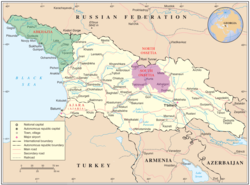
It is a shame to deny a person to visit his home in his homeland. I can only imagine the pain and anguish people felt during the division of India and Pakistan and the fate of Kashmiri Pandits driven away from Kashmir by the militants and violence in the valley. Not everyone is lucky to settle in a relatively safe land like America (A) outside their native homeland.
Coming back to our story, while man made physical barriers have prevented Mr. Kikorov from visiting his homeland, there are other non-physical but man made and self induced barriers that are preventing Mr. Kikorov joining his wife on the vacation to an alias to Abkhazia. Mr. Kikorov is a business man in Philadelphia who owns a restaurant. The recession (excess leverage induced which is ultimately man-made) has hit his restaurant business badly.He could not afford to close the restaurant and go on a vacation with his wife. So off goes Mrs. Kikorov to an island near the coast of Mexico with her friend.
While bad-luck and responsibilities have restrained Mr. Kikorov, though she could go to the vacation Mrs. Kikorov does not seem to have avoided bad luck either. She had multiple phone calls, emails etc from her manager, her company HR asking her not to come to work within 96 hours of her returning back from the coast of Mexico. Little did she know that in two days into her vacation, Swine flu would break out in Mexico and the whole world is terrorized by the rumor of an impending pandemic. She had to convince the powers that she is healthy, did not come in contact with anyone with a flu on her vacation and that she did not actually go to Mexico.
Not knowing that she jumped through these hoops, I asked how her vacation during our weekly staff meeting. She replied 'And your next question is?' to which I joked 'You don't have swine flu right?'. The whole team joined me in poking fun at her. She gave the safety message for the week about Swine Flu.
Sunday, May 3, 2009
Baby Shower
I had invited a bunch of our friends with their families to the Baby Shower of Seshu on April 25th, 2009. Seshu is due in 5 weeks time. Hopefully things will go well. The mother and baby are doing fine for now.
Some of my colleagues had asked me if I was having the Baby Shower in the Indian tradition or American. I tried to make it a mix of both traditions as I know neither of them completely well (just in this case). This is my first time attending or organizing a Baby Shower.
I had the ladies do their thing in Indian tradition at the beginning of the function. Our friends from New York city were gracious enough to bring the betel leaves and nuts for the function. I had the guests entertained with games like, Guess the Bag(s), Mummy's Tummy, How well do you know the Mommy and Blow the balloon. Indian food was served for lunch in a buffet style while these games were being played. I made the event a co-ed which I believe is an American way of doing it. If I not mistaken, the Indian(Andhra) equivalent-Seemantham is an all women event.
About 30 attended the function, as you will be seeing me counting somewhere in the video. We thank you for coming and bestowing your warm wishes on us. For those who could not make it, here is your chance to view the event via photos and video.
I have a new found respect for feature film editors and directors. You kind of fall in love with every frame of your product. In this case, my brother is the producer of the mother video which was about two hours long. But still, the event being personal to me, I developed an ownership feeling with it. To give a perspective, I spent more time editing the video than on planning and organizing the event. I have managed with terrible pain to edit the length of the video from almost 2 hours to about 15 minutes. So please, please watch the video. Here is the link to it.
I personally like paintings better than sculptures, 2D better than 3D, photos better than videos. So, here are the pictures from the function. As you can see Seshu is looking gorgeous as ever.
While I am anxiously waiting for the Baby, Seshu is very tired now and wants to have Baby out as early as possible. We thank you all for your well wishes and will send an update one more time when our baby is born.
Some of my colleagues had asked me if I was having the Baby Shower in the Indian tradition or American. I tried to make it a mix of both traditions as I know neither of them completely well (just in this case). This is my first time attending or organizing a Baby Shower.
I had the ladies do their thing in Indian tradition at the beginning of the function. Our friends from New York city were gracious enough to bring the betel leaves and nuts for the function. I had the guests entertained with games like, Guess the Bag(s), Mummy's Tummy, How well do you know the Mommy and Blow the balloon. Indian food was served for lunch in a buffet style while these games were being played. I made the event a co-ed which I believe is an American way of doing it. If I not mistaken, the Indian(Andhra) equivalent-Seemantham is an all women event.
About 30 attended the function, as you will be seeing me counting somewhere in the video. We thank you for coming and bestowing your warm wishes on us. For those who could not make it, here is your chance to view the event via photos and video.
I have a new found respect for feature film editors and directors. You kind of fall in love with every frame of your product. In this case, my brother is the producer of the mother video which was about two hours long. But still, the event being personal to me, I developed an ownership feeling with it. To give a perspective, I spent more time editing the video than on planning and organizing the event. I have managed with terrible pain to edit the length of the video from almost 2 hours to about 15 minutes. So please, please watch the video. Here is the link to it.
I personally like paintings better than sculptures, 2D better than 3D, photos better than videos. So, here are the pictures from the function. As you can see Seshu is looking gorgeous as ever.
While I am anxiously waiting for the Baby, Seshu is very tired now and wants to have Baby out as early as possible. We thank you all for your well wishes and will send an update one more time when our baby is born.
Tuesday, April 14, 2009
Sign Of Times
Times have changed definitely in the last year or so. I have been reading a lot of stories on how the current crisis has affected people's behavior and how businesses are struggling. Below are some links to news that show the signs of our current times.
A 99cent store goes bust by a 98cent store across the street. More Here.
Increase in Vasectomies as couples find it difficult to raise kids. More here.
Couples putting off their divorces to stave off tough times. More here.
Counties charging fees to respond to accidents to cover shrinking budgets. More here.
Driving Tickets on the rise as municipalities try to raise revenue. More here.
Increase in adults moving in with parents/relatives on loss of jobs/homes. More here.
Doctors see increase in patients seeking help with anxiety and stress. More here.
The above are news clipping from here and there. On a personal level, the sign that times have changed can be seen in the picture below. A old saying says 'A picture is worth a thousand words'.

This is the picture of the refrigerator at my work that I took recently. I wish I had taken a picture of it a year ago. This would have conveyed the story I am trying to make. If few six, seven digit earning analysts could predict that the house prices can go down causing this bubble, how could I predict that there was a story in my work refrigerator. For lack of a picture, I will resort to words(in less than thousand words).
Nothing has changed, my location is same and the refrigerator at work is the same old one. But just a year or year and half ago, half of the refrigerator would be empty. There were very few people that were bringing food from home. Nowadays, almost everyone I know around me are bringing home made food or left overs for lunch.
Lunch is not the only thing that is occupying the space. Breakfast too is being brought from home. The fridge is being stacked with all kinds of 1/2 gallon milk cartons - non fat, low fat. 2%, whole, Soy-milk, over the moon(milk that tastes like whole milk but is low fat milk). My colleagues are bringing breakfast from home or buying them at a retailer like Trader Joe's, Whole foods etc in bulk, instead of on a daily basis at the cafeteria or at any retailer on their way to work(Dunkin Donuts, Wawa and Starbucks or roadside vendor close to work were most popular).
I am not sure if this change to more prudent living is here to stay. I believe, it is not from a conscious thought process that frugal living is good for them. it has to do with the insecurity brought over by the bad economy. There are wild speculations that this recession has created a new paradigm, a change in the way people look at their way of living and how they spend money. Some of these analysts are worried that the economy will see a lot more savings, thereby causing the recession to recover slower.
I am not sure about that latter part. But savings need to be increased a lot more to have a stable, secure households to which they can fall back on in times of crisis. The current model of consumer spending driven economy has produced more recessions at a alarming increasing frequency. Back in 2000 they used to tell that economy goes in cycle and a recession comes once ever decade or so. The period between the current and previous recession is only 4 years. This increased frequency of uncertainty is definitely not a good sign.
A 99cent store goes bust by a 98cent store across the street. More Here.
Increase in Vasectomies as couples find it difficult to raise kids. More here.
Couples putting off their divorces to stave off tough times. More here.
Counties charging fees to respond to accidents to cover shrinking budgets. More here.
Driving Tickets on the rise as municipalities try to raise revenue. More here.
Increase in adults moving in with parents/relatives on loss of jobs/homes. More here.
Doctors see increase in patients seeking help with anxiety and stress. More here.
The above are news clipping from here and there. On a personal level, the sign that times have changed can be seen in the picture below. A old saying says 'A picture is worth a thousand words'.

This is the picture of the refrigerator at my work that I took recently. I wish I had taken a picture of it a year ago. This would have conveyed the story I am trying to make. If few six, seven digit earning analysts could predict that the house prices can go down causing this bubble, how could I predict that there was a story in my work refrigerator. For lack of a picture, I will resort to words(in less than thousand words).
Nothing has changed, my location is same and the refrigerator at work is the same old one. But just a year or year and half ago, half of the refrigerator would be empty. There were very few people that were bringing food from home. Nowadays, almost everyone I know around me are bringing home made food or left overs for lunch.
Lunch is not the only thing that is occupying the space. Breakfast too is being brought from home. The fridge is being stacked with all kinds of 1/2 gallon milk cartons - non fat, low fat. 2%, whole, Soy-milk, over the moon(milk that tastes like whole milk but is low fat milk). My colleagues are bringing breakfast from home or buying them at a retailer like Trader Joe's, Whole foods etc in bulk, instead of on a daily basis at the cafeteria or at any retailer on their way to work(Dunkin Donuts, Wawa and Starbucks or roadside vendor close to work were most popular).
I am not sure if this change to more prudent living is here to stay. I believe, it is not from a conscious thought process that frugal living is good for them. it has to do with the insecurity brought over by the bad economy. There are wild speculations that this recession has created a new paradigm, a change in the way people look at their way of living and how they spend money. Some of these analysts are worried that the economy will see a lot more savings, thereby causing the recession to recover slower.
I am not sure about that latter part. But savings need to be increased a lot more to have a stable, secure households to which they can fall back on in times of crisis. The current model of consumer spending driven economy has produced more recessions at a alarming increasing frequency. Back in 2000 they used to tell that economy goes in cycle and a recession comes once ever decade or so. The period between the current and previous recession is only 4 years. This increased frequency of uncertainty is definitely not a good sign.
Labels:
Economy,
Prudence,
Saving Money
Thursday, March 12, 2009
Green Storm in a Coffee Cup
Someone decided to go green at my workplace a few months ago. So, they cut the disposable cups for coffee/tea completely and distributed reusable plastic mugs instead. The underlying thesis is that this would reduce the carbon footprint. I am not in agreement with that thesis to which I will get to later. But the story goes beyond green here and took some funny turns.
The lady who distributed the cups thought I was an employee and gave me the box containing the reusable mug. I cheerfully placed my hands on the box accepting it. While I did, she asked me if I was an employee, to which I said 'No'. She grabbed the cup out of my hands and said 'Sorry! No cups for contractors'.
This incident here led to a discussion in the company. Are contractors not allowed to drink coffee anymore, or should the company have disposables for them thereby effecting the carbon footprint reduction targets. More importantly, diversity is a key issue and complete removal of disposables kept 40% of the company's workforce without coffee. This incident reached my team manager and then the IT Department director. I do not know what happened behind closed doors, but I had a mug on my desk the next morning.
I came to know later that my manager took care of the issue. I thanked her for the goodwill gesture. As always in any society, there will be people who are smart and quick to grab chances to self propel. One Employee used this incident to enhance his year end review. This same guy, in the immediate aftermath of the incident, argued that contractors were not allowed to the same benefits as employees.
Coffee and controversies seem to go hand in hand not only in my life but across the globe. There was an incident recently at European Union, where they had bought about 21 Deluxe Espresso machines for about $7500. Have these financial wizards considered the basics of economics. How many espressos should be delivered from the machine to break even the cost at $7500? Also what makes these executives at EU so special that they needed a Espresso only from an espresso machine that costs $7500 and not from some $75 machine which are not cheap by any means. It was found that the water coming from these machines 'had high levels of nickel and elevated amounts of lead'. This of course led to a huge uproar about the irrational wasteful spending in this economy at the Union head quarters. This was reported on CNBC.
My tryst with Caffeine has come to end now; at least temporarily. I have been observing mild palpitations during or immediately after my afternoon dosage of caffeine(coffee and/or tea). My doctor tells me that caffeine can cause heart palpitations and anxiety. She told me to be off of caffeine for about 2 months and monitor the frequency of the same. If you considering quitting caffeine, here are 10 reasons.
But the real point I want to bring out is - Is it really green having coffee in reusable mugs(porcelain/plastic/steel etc) as against disposable Styrofoam or paper cups? To me, it all comes down to money. But most times, cost is not an easy parameter to compare. The cost on one side of this debate is known - that of the reusable cup and only if you buy it. But the cost involved in using a disposable cup is difficult to know unless you are a coffee vendor. The cost of the disposable cup is passed on the to the coffee consumer and is highly intangible to the consumer.
By bringing greenbacks into the story, I bypassed the point of going green. The real point is not greenback but the carbon footprint or indirectly the energy consumed and also the biodegradability. We know about biodegradability and recycling issues of both the choices. I just want to compare the energy consumed with both here. Most of my views here are mostly from a post on Slate here.
The Ceramic mug takes 70 times more energy to make it as compared with a Styrofoam cup. This is because the ceramic mug is lot heavier than the Styrofoam cup and hence more energy to produce it and ship(transport) it from the manufacturing plant to the retail store. But the equation does not end there. A disposable cup goes to a dumpster or to a recycle bin if your workplace has a recycle bin for used Styrofoam cups(highly unlikely). The life of a reusable cup is much longer. But it also involves a lot more maintenance - cleaning and washing.
The washing liquid has it's own carbon footprint which can be minimal considering how much we use to wash it. It becomes enormous though when you consider how many times we wash a cup in it's lifetime (at least 200 times in a year in my case as I work almost 200 days in a year and drink coffee daily with a reusable mug). A prudent and green conscious consumer's mug can easily have a lifetime of 4 years. That is almost 800 washes.
The water used for cleaning is also a wastage of the precious commodity that easily goes unnoticed. If the water used is hot, which is most likely the case, there is more energy spent to heat the water. An old study reveals that washing with hot water will take as much energy and emissions as is involved in making a Styrofoam cup. So the green monger should clean with cold water only occasionally and that too with phosphate free dish washing liquid. Apparently dish washing detergents containing phosphates 'can cause ecologically harmful algal blooms in waterways' as is stated here. One is also more likely to reheat the caffeine beverage in a reusable container rather than that it a disposable one.
Taking all the energy consumption involved, it is not such a bad idea to use a disposable cup. If you really want to take the reusable path, resist from buying a new one unless you have to absolutely. Get one from home, or use one that is left unused in the work kitchen. Clean with phosphate free dish washing liquid and rinse with cold water. If all this is too much work, feel free to use the disposable without guilt but exercise prudence. What appears to be quite obvious on the outset is actually not the truth; there is more depth to the story with a completely different perspective than that is obvious.
The lady who distributed the cups thought I was an employee and gave me the box containing the reusable mug. I cheerfully placed my hands on the box accepting it. While I did, she asked me if I was an employee, to which I said 'No'. She grabbed the cup out of my hands and said 'Sorry! No cups for contractors'.
This incident here led to a discussion in the company. Are contractors not allowed to drink coffee anymore, or should the company have disposables for them thereby effecting the carbon footprint reduction targets. More importantly, diversity is a key issue and complete removal of disposables kept 40% of the company's workforce without coffee. This incident reached my team manager and then the IT Department director. I do not know what happened behind closed doors, but I had a mug on my desk the next morning.
I came to know later that my manager took care of the issue. I thanked her for the goodwill gesture. As always in any society, there will be people who are smart and quick to grab chances to self propel. One Employee used this incident to enhance his year end review. This same guy, in the immediate aftermath of the incident, argued that contractors were not allowed to the same benefits as employees.
Coffee and controversies seem to go hand in hand not only in my life but across the globe. There was an incident recently at European Union, where they had bought about 21 Deluxe Espresso machines for about $7500. Have these financial wizards considered the basics of economics. How many espressos should be delivered from the machine to break even the cost at $7500? Also what makes these executives at EU so special that they needed a Espresso only from an espresso machine that costs $7500 and not from some $75 machine which are not cheap by any means. It was found that the water coming from these machines 'had high levels of nickel and elevated amounts of lead'. This of course led to a huge uproar about the irrational wasteful spending in this economy at the Union head quarters. This was reported on CNBC.
My tryst with Caffeine has come to end now; at least temporarily. I have been observing mild palpitations during or immediately after my afternoon dosage of caffeine(coffee and/or tea). My doctor tells me that caffeine can cause heart palpitations and anxiety. She told me to be off of caffeine for about 2 months and monitor the frequency of the same. If you considering quitting caffeine, here are 10 reasons.
But the real point I want to bring out is - Is it really green having coffee in reusable mugs(porcelain/plastic/steel etc) as against disposable Styrofoam or paper cups? To me, it all comes down to money. But most times, cost is not an easy parameter to compare. The cost on one side of this debate is known - that of the reusable cup and only if you buy it. But the cost involved in using a disposable cup is difficult to know unless you are a coffee vendor. The cost of the disposable cup is passed on the to the coffee consumer and is highly intangible to the consumer.
By bringing greenbacks into the story, I bypassed the point of going green. The real point is not greenback but the carbon footprint or indirectly the energy consumed and also the biodegradability. We know about biodegradability and recycling issues of both the choices. I just want to compare the energy consumed with both here. Most of my views here are mostly from a post on Slate here.
The Ceramic mug takes 70 times more energy to make it as compared with a Styrofoam cup. This is because the ceramic mug is lot heavier than the Styrofoam cup and hence more energy to produce it and ship(transport) it from the manufacturing plant to the retail store. But the equation does not end there. A disposable cup goes to a dumpster or to a recycle bin if your workplace has a recycle bin for used Styrofoam cups(highly unlikely). The life of a reusable cup is much longer. But it also involves a lot more maintenance - cleaning and washing.
The washing liquid has it's own carbon footprint which can be minimal considering how much we use to wash it. It becomes enormous though when you consider how many times we wash a cup in it's lifetime (at least 200 times in a year in my case as I work almost 200 days in a year and drink coffee daily with a reusable mug). A prudent and green conscious consumer's mug can easily have a lifetime of 4 years. That is almost 800 washes.
The water used for cleaning is also a wastage of the precious commodity that easily goes unnoticed. If the water used is hot, which is most likely the case, there is more energy spent to heat the water. An old study reveals that washing with hot water will take as much energy and emissions as is involved in making a Styrofoam cup. So the green monger should clean with cold water only occasionally and that too with phosphate free dish washing liquid. Apparently dish washing detergents containing phosphates 'can cause ecologically harmful algal blooms in waterways' as is stated here. One is also more likely to reheat the caffeine beverage in a reusable container rather than that it a disposable one.
Taking all the energy consumption involved, it is not such a bad idea to use a disposable cup. If you really want to take the reusable path, resist from buying a new one unless you have to absolutely. Get one from home, or use one that is left unused in the work kitchen. Clean with phosphate free dish washing liquid and rinse with cold water. If all this is too much work, feel free to use the disposable without guilt but exercise prudence. What appears to be quite obvious on the outset is actually not the truth; there is more depth to the story with a completely different perspective than that is obvious.
Labels:
Coffee,
Environment,
Green
Sunday, February 22, 2009
Leverage Rich Vs. Poor
Muhammad Yunus of Grameen Bank was asked on CNBC what is so different with micro credit from the current credit crisis that makes it a success. To them Micro credit can also lead to something similar to the current credit crisis. Micro credit gives credit to non-traditional (high default risk) credit seeking people in a more tradition way (the other way for Grameen's customers is to go to Loan Sharks) through Grameen Bank. The current credit crisis is also caused by excess debt taken on by people who do not have a decent income to pay the debt and have bad credit scores.
The host of fast money (true to the Show's name everyone on the show, including the host Dillan Ratigan, speak really fast cutting into each other ever so often), asked the same question to Mr.Yunus (Nobel Prize recipient for his work on Micro Credit). He answered that the Grameen's goal is not to make money out of the loan from the people but to help the people develop self employment. After the interview with Mr.Yunus, the gang on the show was shouting on top of each other that the goal of capitalism is making money and that there is nothing wrong in that thinking. Here is the video of that episode of Fast Money on CNBC.
On a brief thought the Fast Money experts (not so truly experts) appear to be correct. How can the people with no income and no credit history at all be given loans without the expectation of any returns? Would one loan a beggar 10 dollars and expect him to repay the loan? Conventional wisdom says 'NO'. Now replace the beggar with any other human with abnormally low income producing job or one that is struggling to lead a day to day life. To me, day to day life means feeding oneself and his/her family a decent enough meal three times a day. Again, conventional wisdom tells us 'NO'. If we look at the current crisis, people were given loans that at least had some kind of income though they were reported to be earning more than their real income. With this loan they bought homes in anticipation that the home prices will continue going higher for ever and that they (The lender and debt holder) could live happily ever after. But we have seen the credit crisis unfold before us in the last 2 years. So how can we trust someone with one credible source of income, when the smartest loan lenders in US and across the globe failed?
To that traditional thinking if we add the fact that the repayment rate of the micro credit loans is as high as 99.5%. Yes that is a staggeringly high number, a number so high not even the best banks lending to the richest in the world could match. So where is the difference between these two worlds? Mr.Yunus recreated this success over the last three decade or so with his Grameen bank in Bangladesh and around the world.
So we see that both traditional and non-traditional systems lent money to high risk credit seeking people. But one lost a limb and an arm and is still struggling to get up, while the other is walking tall with a aura of improving the human lives and conditions in the remotest and poorest parts of the world.
The Grameen bank was started and still operates with the motto of helping the poor. There is no expectation of a repayment leave alone the expectation of a profit. But to everyone's surprise including the founders, the loans kept being repaid at a high percentage. This micro credit is their only door to a brighter future and they could not risk losing that security blanket by defaulting the loan.To these poor people taking loans, Grameen Bank was their last straw at changing their lives; changing lives where they can have food for themselves and their children, send their kids to school, have a safe roof over their top, clean water to drink.
All these are basic amenities where the lenders and debt takers of the modern rich world are totally unaware of. They were loading themselves with debt beyond their abilities not because they were lacking the basic amenities, but out of greed. They wanted to make a quick buck; they did not want to be left behind in the race. This greed is what caused the leveraging and this greed is what's causing the collapse.
Here is a video of Mr.Yunus on CNBC during the recent economic summit in Davos. Here you can see in the early part of the video that the Brooklyn branch of Grameen has given out loans exceeding million dollars to about five hundred seekers with a repayment rate of 99.5%. The experiment paid off in West as it did in the East. Geography was not a factor in its success.
One question that truly surprised me in that video was 'Who does not have enough food in the world and how do we feed them?' - that is the world some of these people live in, but for millions in the world 'hunger' is a reality and helping these folks gain income producing employment should be the priority. May be it is time to rethink the traditional teachings of modern education and do something on my part towards this cause.
The host of fast money (true to the Show's name everyone on the show, including the host Dillan Ratigan, speak really fast cutting into each other ever so often), asked the same question to Mr.Yunus (Nobel Prize recipient for his work on Micro Credit). He answered that the Grameen's goal is not to make money out of the loan from the people but to help the people develop self employment. After the interview with Mr.Yunus, the gang on the show was shouting on top of each other that the goal of capitalism is making money and that there is nothing wrong in that thinking. Here is the video of that episode of Fast Money on CNBC.
On a brief thought the Fast Money experts (not so truly experts) appear to be correct. How can the people with no income and no credit history at all be given loans without the expectation of any returns? Would one loan a beggar 10 dollars and expect him to repay the loan? Conventional wisdom says 'NO'. Now replace the beggar with any other human with abnormally low income producing job or one that is struggling to lead a day to day life. To me, day to day life means feeding oneself and his/her family a decent enough meal three times a day. Again, conventional wisdom tells us 'NO'. If we look at the current crisis, people were given loans that at least had some kind of income though they were reported to be earning more than their real income. With this loan they bought homes in anticipation that the home prices will continue going higher for ever and that they (The lender and debt holder) could live happily ever after. But we have seen the credit crisis unfold before us in the last 2 years. So how can we trust someone with one credible source of income, when the smartest loan lenders in US and across the globe failed?
To that traditional thinking if we add the fact that the repayment rate of the micro credit loans is as high as 99.5%. Yes that is a staggeringly high number, a number so high not even the best banks lending to the richest in the world could match. So where is the difference between these two worlds? Mr.Yunus recreated this success over the last three decade or so with his Grameen bank in Bangladesh and around the world.
So we see that both traditional and non-traditional systems lent money to high risk credit seeking people. But one lost a limb and an arm and is still struggling to get up, while the other is walking tall with a aura of improving the human lives and conditions in the remotest and poorest parts of the world.
The Grameen bank was started and still operates with the motto of helping the poor. There is no expectation of a repayment leave alone the expectation of a profit. But to everyone's surprise including the founders, the loans kept being repaid at a high percentage. This micro credit is their only door to a brighter future and they could not risk losing that security blanket by defaulting the loan.To these poor people taking loans, Grameen Bank was their last straw at changing their lives; changing lives where they can have food for themselves and their children, send their kids to school, have a safe roof over their top, clean water to drink.
All these are basic amenities where the lenders and debt takers of the modern rich world are totally unaware of. They were loading themselves with debt beyond their abilities not because they were lacking the basic amenities, but out of greed. They wanted to make a quick buck; they did not want to be left behind in the race. This greed is what caused the leveraging and this greed is what's causing the collapse.
Here is a video of Mr.Yunus on CNBC during the recent economic summit in Davos. Here you can see in the early part of the video that the Brooklyn branch of Grameen has given out loans exceeding million dollars to about five hundred seekers with a repayment rate of 99.5%. The experiment paid off in West as it did in the East. Geography was not a factor in its success.
One question that truly surprised me in that video was 'Who does not have enough food in the world and how do we feed them?' - that is the world some of these people live in, but for millions in the world 'hunger' is a reality and helping these folks gain income producing employment should be the priority. May be it is time to rethink the traditional teachings of modern education and do something on my part towards this cause.
Thursday, February 19, 2009
AR Rahman best
In lieu of the 3 Oscar nominations to AR Rahman, I compiled for my colleague at work a list of some of my favourite AR Rahman songs from over a period of time. Here is the list. Click on the song name to open the video in You Tube. The Oscars are live on ABC at February 22nd, 2009 at 8 PM EST.
Rang De Basanti - Roo Ba Roo
Jiya Jale - Dil Se
Taal - Taal se taal mila
Rangeela - Mangta hai kya
Dil Se - Chaiyya Chaiyya
Meenaxi - Chinnamma Chilakamma
Prema Desam - Mustafa Mustafa
Premikuldu - Mukkala Mukkabula
Kadhalan - Urvasi Urvasi
Gentleman - Chiku Buku Raile
Roja - Roja Jaaneman
Ofcourse the latest has to be in the list. So here it is.
Slumdog Milliannaire - Jai Ho
Rang De Basanti - Roo Ba Roo
Jiya Jale - Dil Se
Taal - Taal se taal mila
Rangeela - Mangta hai kya
Dil Se - Chaiyya Chaiyya
Meenaxi - Chinnamma Chilakamma
Prema Desam - Mustafa Mustafa
Premikuldu - Mukkala Mukkabula
Kadhalan - Urvasi Urvasi
Gentleman - Chiku Buku Raile
Roja - Roja Jaaneman
Ofcourse the latest has to be in the list. So here it is.
Slumdog Milliannaire - Jai Ho
Labels:
A R Rahman,
Indian Movie Songs
Wednesday, February 4, 2009
More on my problems with Airports
This is a concluding part of my previous post - Why I hate Airports.
Also one has to deal with one or all of the following people - 1. Indifferent, 2. Meddlesome and 3. Moody. To fully understand my case, I have to explain my recent experience where I had to deal with all three kinds (Indifferent, Meddlesome and Moody) of people and the other baggage (pun intended) that comes with it.
We reached the airport at around 3:00 PM. The sign board at the ramp signaled that the Air India departures were at Terminal B. That was all good. But on reaching the Terminal B, there was hardly any space to stop. Nor was there a sign for Air India on the gates. I saw Jet Airways gate and that is where I decided my stop would be. I somehow found a nook to stop and put my hazard lights on. I unloaded the bags from my car trunk and took them into the terminal to find the Air India gate. I had asked a couple of airport personnel where the Air India ticket counter was. Both of them were indifferent. Finally a third guy responded that the Air India was level 2 and pointed to the right. I thought from his pointing that Level 2 was the far right end of the same floor. As I dragged along, my eyes fell on the elevator and I saw a small yellow sign reading Air India.
Apparently they shifted the Air India to the basement of the airport, I mean Level 2, while all the other airlines were at the main level. I handed over the responsibility of the bags to my wife and headed back to my car to park it. All this while, I was scared of my car being towed away. It had been parked for a long time without anyone in the car.
I drove to the parking lot, took the parking ticket and headed to the Air India check-in counter where my wife and mother-in-law were waiting. The line was huge as always. But in all this chaos I saw a digital weighing machine at the end of the line. There was a row of seats to the left of the weighing machine with two old men sitting. They appeared to be in their mid 60s. A few feet in front of the weighing machine were a few other passengers and their families. I took the bags and placed one bag on the weighing machine. This action of mine somehow generated an extreme interest in one of the old gentlemen. He jumped out of his chair and began to look at what I was doing. He saw the same thing I saw and he quickly blurted out said 52 lbs. He said that to me and his friend who was still sitting. He turned to me and said 'Its OK'. I took the bag off the machine and took it back a few feet where my wife and mother-in-law were standing. I came back with the second suitcase and laid it on the machine floor. This time I saw it as 25. I couldn't believe it. The old man who was still there jumped again and said in some broken Hindi 'I changed it to Kgs. It is now easy for you. 25 may be tough'. I knew that Kgs is short for Kilos or Kilograms.
I am already bothered now by the actions of the old guy. I brought the cabin bag and weighed. The old man said 'It is 8.8 Kgs you should be fine'. My wife took out the heavy hard cover books from both the suitcases. I weighed them again. The meddlesome old man now gave me a pass signal with for 23 and 23.5 Kgs each. I did not know if I was to feel happy for the help or feel aggravated at his meddlesomeness. But I couldn't be distracted by this; I had miles to go before I sleep. Yes, literally I have 125 miles more to go before I really sleep and that was hours away.
We waited in line at the check-in counter. When it was our turn, the guy behind the counter greeted us and told to place one bag on the pedestal to weigh it. I put on of the check-in suticase and for some reason it was already showing 2.0 Kgs and did not change. He rudely says to me in a low voice, 'Can you take it off the machine'. I had him repeat twice to understand what he was saying. I took the bag off and he reset the machine which showed 0.0. I replaced the bag and it read 23.2 Kgs. I was relieved when he took the bag in and said it was ok. The calculator inside was telling me it was overweight by a pound. I placed the second bag and it read 23.8 Kgs. This time also he took the bag in and said it was ok. I was really happy now as I had passed 3 pounds of excess baggage. It was kind of a sweet revenge from my previous experience where I had to pay the fine for excess bag weight.
He seemed to be in a pleasant mood. He silently came close to me said I could put any stuff in the 2 bags that were checked-in if I wanted to. I was surprised at his generosity and asked my wife to hand me the books she was holding, to put them in the bags. Before I could put them, he asked if I had carry-on bag. I said yes and placed that on the scale. It read 8.8 Kgs. He said 'You can put whatever you want in this bag and I will check it in also. You can pick them up at the Mumbai Airport'. I explained this to my Mother-in-law to see if she was comfortable doing that. She said no and wanted to keep it with on the flight. This must have pissed off the guy. He said 'I put the tags to the carry-on bag. Do not ADD ANYTHING to this after you go up. They will check the weight again and fine you'.
I should have noticed the change in his tone and mood. If I had enough Emotional Intelligence Quotient (EQ), I would have known not to bother him anymore and move away from there. But the Indian in me wanted to bargain. I asked if I could put the books for kids (I was using the sympathy bait too) in the already checked-in bags. He said ‘NO, that would make the bags overweight’ and that I had to pay for the excess baggage. Sanity prevailed in me and I took the tickets. We quickly moved away from there to the ticket issuing counter at the left end corner of the room.
From here on, my wife took over. I guess women have a better EQ or others tend to be nice to them. It may be a combination of both. The lady behind the counter was very courteous to us now. My wife even requested an aisle seat for her mom and got it. I am sure if it was me, I would have gotten 'NO AISLE TICKETS FOR YOU'.
So we went upstairs after collecting the tickets and stood in a long line for coffee and some food. For some reason, people go crazy over food in crowded places. It took thirty minutes to get a cup of coffee and Vegetarian flied lice (I mean fried rice) at a Chinese fast food vendor. I had to go vegetarian as it was an auspicious day. We said our goodbyes to my mother-in-law at around 6:30 PM, paid the insanely expensive parking fee ($3 for every 1/2 hour) and headed to the Bridgewater temple, and then reached home at 10:05 PM.
I thought that the ordeal was over. But life of late seems like a day in the movie 'Groundhog Day' where the lead weatherman lives the same day over and over again. I have to make a trip to the airport again this month. Only this time I will be picking a different person, my brother, at a different airport.
-------------------------------------------------------------------------------------
As a side note, there is also a certification in Emotional Quotient. One of my friends recommended Daniel Goleman's 'Emotional Intelligence' which is on my list to read in the future.
Also one has to deal with one or all of the following people - 1. Indifferent, 2. Meddlesome and 3. Moody. To fully understand my case, I have to explain my recent experience where I had to deal with all three kinds (Indifferent, Meddlesome and Moody) of people and the other baggage (pun intended) that comes with it.
We reached the airport at around 3:00 PM. The sign board at the ramp signaled that the Air India departures were at Terminal B. That was all good. But on reaching the Terminal B, there was hardly any space to stop. Nor was there a sign for Air India on the gates. I saw Jet Airways gate and that is where I decided my stop would be. I somehow found a nook to stop and put my hazard lights on. I unloaded the bags from my car trunk and took them into the terminal to find the Air India gate. I had asked a couple of airport personnel where the Air India ticket counter was. Both of them were indifferent. Finally a third guy responded that the Air India was level 2 and pointed to the right. I thought from his pointing that Level 2 was the far right end of the same floor. As I dragged along, my eyes fell on the elevator and I saw a small yellow sign reading Air India.
Apparently they shifted the Air India to the basement of the airport, I mean Level 2, while all the other airlines were at the main level. I handed over the responsibility of the bags to my wife and headed back to my car to park it. All this while, I was scared of my car being towed away. It had been parked for a long time without anyone in the car.
I drove to the parking lot, took the parking ticket and headed to the Air India check-in counter where my wife and mother-in-law were waiting. The line was huge as always. But in all this chaos I saw a digital weighing machine at the end of the line. There was a row of seats to the left of the weighing machine with two old men sitting. They appeared to be in their mid 60s. A few feet in front of the weighing machine were a few other passengers and their families. I took the bags and placed one bag on the weighing machine. This action of mine somehow generated an extreme interest in one of the old gentlemen. He jumped out of his chair and began to look at what I was doing. He saw the same thing I saw and he quickly blurted out said 52 lbs. He said that to me and his friend who was still sitting. He turned to me and said 'Its OK'. I took the bag off the machine and took it back a few feet where my wife and mother-in-law were standing. I came back with the second suitcase and laid it on the machine floor. This time I saw it as 25. I couldn't believe it. The old man who was still there jumped again and said in some broken Hindi 'I changed it to Kgs. It is now easy for you. 25 may be tough'. I knew that Kgs is short for Kilos or Kilograms.
I am already bothered now by the actions of the old guy. I brought the cabin bag and weighed. The old man said 'It is 8.8 Kgs you should be fine'. My wife took out the heavy hard cover books from both the suitcases. I weighed them again. The meddlesome old man now gave me a pass signal with for 23 and 23.5 Kgs each. I did not know if I was to feel happy for the help or feel aggravated at his meddlesomeness. But I couldn't be distracted by this; I had miles to go before I sleep. Yes, literally I have 125 miles more to go before I really sleep and that was hours away.
We waited in line at the check-in counter. When it was our turn, the guy behind the counter greeted us and told to place one bag on the pedestal to weigh it. I put on of the check-in suticase and for some reason it was already showing 2.0 Kgs and did not change. He rudely says to me in a low voice, 'Can you take it off the machine'. I had him repeat twice to understand what he was saying. I took the bag off and he reset the machine which showed 0.0. I replaced the bag and it read 23.2 Kgs. I was relieved when he took the bag in and said it was ok. The calculator inside was telling me it was overweight by a pound. I placed the second bag and it read 23.8 Kgs. This time also he took the bag in and said it was ok. I was really happy now as I had passed 3 pounds of excess baggage. It was kind of a sweet revenge from my previous experience where I had to pay the fine for excess bag weight.
He seemed to be in a pleasant mood. He silently came close to me said I could put any stuff in the 2 bags that were checked-in if I wanted to. I was surprised at his generosity and asked my wife to hand me the books she was holding, to put them in the bags. Before I could put them, he asked if I had carry-on bag. I said yes and placed that on the scale. It read 8.8 Kgs. He said 'You can put whatever you want in this bag and I will check it in also. You can pick them up at the Mumbai Airport'. I explained this to my Mother-in-law to see if she was comfortable doing that. She said no and wanted to keep it with on the flight. This must have pissed off the guy. He said 'I put the tags to the carry-on bag. Do not ADD ANYTHING to this after you go up. They will check the weight again and fine you'.
I should have noticed the change in his tone and mood. If I had enough Emotional Intelligence Quotient (EQ), I would have known not to bother him anymore and move away from there. But the Indian in me wanted to bargain. I asked if I could put the books for kids (I was using the sympathy bait too) in the already checked-in bags. He said ‘NO, that would make the bags overweight’ and that I had to pay for the excess baggage. Sanity prevailed in me and I took the tickets. We quickly moved away from there to the ticket issuing counter at the left end corner of the room.
From here on, my wife took over. I guess women have a better EQ or others tend to be nice to them. It may be a combination of both. The lady behind the counter was very courteous to us now. My wife even requested an aisle seat for her mom and got it. I am sure if it was me, I would have gotten 'NO AISLE TICKETS FOR YOU'.
So we went upstairs after collecting the tickets and stood in a long line for coffee and some food. For some reason, people go crazy over food in crowded places. It took thirty minutes to get a cup of coffee and Vegetarian flied lice (I mean fried rice) at a Chinese fast food vendor. I had to go vegetarian as it was an auspicious day. We said our goodbyes to my mother-in-law at around 6:30 PM, paid the insanely expensive parking fee ($3 for every 1/2 hour) and headed to the Bridgewater temple, and then reached home at 10:05 PM.
I thought that the ordeal was over. But life of late seems like a day in the movie 'Groundhog Day' where the lead weatherman lives the same day over and over again. I have to make a trip to the airport again this month. Only this time I will be picking a different person, my brother, at a different airport.
-------------------------------------------------------------------------------------
As a side note, there is also a certification in Emotional Quotient. One of my friends recommended Daniel Goleman's 'Emotional Intelligence' which is on my list to read in the future.
Labels:
Airport,
Indian in US.
Saturday, January 24, 2009
Sahityam in Telugu Movie Songs
I had the Telugu movie bug in me since child hood. I was not an avid movie goer, but movie songs were a different story. I literally grew up waking up to the AIR Bhakti Lahari at 8:00 in the morning and Commercial movie songs at 9:00AM. My mom is a big fan of AIR even today when TV is a big thing. So I had listened to a lot of good Telugu movie music during those days.
While there definitely was a lot of good music then, there is load of bad music the last decade or so. I am not just talking about mediocrity of the composition, but more importantly the lyrics - Sahityam of the songs and the diction of the singers. Here are some of the few lines from here and there that bother me a lot.
1. Jakir Hussain tabla nuvvena - What kind of a reference is that?
2. Kullina Vankaya lo Jata purugulamai undam - Really, is that the best a couple would want to be like?
3. Naa Dress meeda ice cream vesi po - Oke Okkadu Movie Shakalaka baby - Yes that is a great way to entice a guy to make him fall in love with you.
Much of the above can be attributed to the hugely popular music by A.R.Rahman (hereto by referred to as ARR) where the translation from Tamil to Telugu was literal. In fact some of those dubbed movies of ARR were produced by A.M.Ratnam and he took the onus on himself to script (translate) the lyrics. I am not attributing the sole cause of this to ARR. But somehow the genius in his music lead to some unpardonable lyrics in his songs and became very accepted. His instrumentation and foot-tapping music dominates so much of the song that nobody other than few miserable souls like me have tried to make any sense of the lyrics and raised their voice against them. In Telugu everyone from Veturi, Bhuvana Chandra to Chandrabose are guilty of doing this. Sirivennela to certain extent has not been a part of this menace. Apparently, the same fate had been with Tamil Music composed by ARR and lyricist accomplice in this case was Vairamuthu. But the astonishing fact is that, the same fate escaped the Hindi music that ARR composed. He produced some great music in Hindi without compromising on the lyrics of these songs. Clearly the cause should be attributed to someone else other than ARR. It could be the Lyricist, Director and/or the Producer of these movies.
All the above examples were from dubbing movies. But I would be completely out of my mind if I put the blame on dubbing movies alone. That takes the blame away from our own industry which for decades has produced some insane lyrics themselves. My recent memory of bad lyrics is from a direct movie of our ever young hero Balayya's song 'Lux papa Lux Papa Lunch ki vostava'. What do you mean by Lux Papa and why are asking Lux to come for Lunch with you? That is sheer madness. Some other examples are 'Adis Ababa Allam Murabba choosthava naa debba' and 'Koko Komali korukku thinnadi kolatam lo'. I did not mean to pick our Balayya on this, but all the examples that I can think of came from his movies coincidentally (or are they).
The other common thread that runs common in dubbed as well as direct movies is the singers of these dreaded songs. Our industry has encouraged the blatant killing of our language by a non-Telugu singer. In fact the first one to introduce and encourage this was our own great late NTR (the irony is that he started a political party based on the pride of Telugu speaking people) who made the great Rafi sing a song in Telugu. The song was ’Naa madi ninnu pilichindi’. I can appreciate Rafi Saab's greatness in voice and his classical music background, but his lack of learning the basics of the language he was singing is very disturbing. I love his music in Hindi, but the 2 songs that I know he sung in Telugu were terrible. The other Telugu song of Rafi I know is ’Entha varu gani’. He breaks a word into multiple words and puts the emphasis on the wrong syllable.
Taking the baton from late Rafi are Udit Narayan, Kumar Sanu, Sonu Nigam, Suresh Peters, Adnan Sami, Sukhwinder Singh etc from our own generation. I don’t think the singers are to be blamed on this. They are probably paid very good money to do what they are doing and I would not be surprised if they were encouraged to sing in as bad a language as they can. It is the movie producers and music directors who in the name of novelty pay exorbitant amounts to these guys to bring such shame to our language. I guess the singers were only doing what they were told to. The producers and directors are doing it because we keep on accepting these songs every time they are thrust on us. We hate them, we find them funny, but we still listen to them and somehow accept them or get used to them.
To this the chorus and some incomprehensible phrases added at liberal doses make the matters go south. E.g.: Mukkambe Mukkambe, Addis Ababa(some one found it funny to have the name of a African Nations capital city as the start line for a song); Jumba Re Aa Jumba Re; Chuku Chuku Cha Cha;
The silver lining is that every once in a while a movie comes with some neat lyrics. Of late the movies made by Sekhar Kammula have some nice enjoyable music with good lyrics, the recent one of which is Happy Days. I do enjoy such songs with a good coffee. There is still hope.
While there definitely was a lot of good music then, there is load of bad music the last decade or so. I am not just talking about mediocrity of the composition, but more importantly the lyrics - Sahityam of the songs and the diction of the singers. Here are some of the few lines from here and there that bother me a lot.
1. Jakir Hussain tabla nuvvena - What kind of a reference is that?
2. Kullina Vankaya lo Jata purugulamai undam - Really, is that the best a couple would want to be like?
3. Naa Dress meeda ice cream vesi po - Oke Okkadu Movie Shakalaka baby - Yes that is a great way to entice a guy to make him fall in love with you.
Much of the above can be attributed to the hugely popular music by A.R.Rahman (hereto by referred to as ARR) where the translation from Tamil to Telugu was literal. In fact some of those dubbed movies of ARR were produced by A.M.Ratnam and he took the onus on himself to script (translate) the lyrics. I am not attributing the sole cause of this to ARR. But somehow the genius in his music lead to some unpardonable lyrics in his songs and became very accepted. His instrumentation and foot-tapping music dominates so much of the song that nobody other than few miserable souls like me have tried to make any sense of the lyrics and raised their voice against them. In Telugu everyone from Veturi, Bhuvana Chandra to Chandrabose are guilty of doing this. Sirivennela to certain extent has not been a part of this menace. Apparently, the same fate had been with Tamil Music composed by ARR and lyricist accomplice in this case was Vairamuthu. But the astonishing fact is that, the same fate escaped the Hindi music that ARR composed. He produced some great music in Hindi without compromising on the lyrics of these songs. Clearly the cause should be attributed to someone else other than ARR. It could be the Lyricist, Director and/or the Producer of these movies.
All the above examples were from dubbing movies. But I would be completely out of my mind if I put the blame on dubbing movies alone. That takes the blame away from our own industry which for decades has produced some insane lyrics themselves. My recent memory of bad lyrics is from a direct movie of our ever young hero Balayya's song 'Lux papa Lux Papa Lunch ki vostava'. What do you mean by Lux Papa and why are asking Lux to come for Lunch with you? That is sheer madness. Some other examples are 'Adis Ababa Allam Murabba choosthava naa debba' and 'Koko Komali korukku thinnadi kolatam lo'. I did not mean to pick our Balayya on this, but all the examples that I can think of came from his movies coincidentally (or are they).
The other common thread that runs common in dubbed as well as direct movies is the singers of these dreaded songs. Our industry has encouraged the blatant killing of our language by a non-Telugu singer. In fact the first one to introduce and encourage this was our own great late NTR (the irony is that he started a political party based on the pride of Telugu speaking people) who made the great Rafi sing a song in Telugu. The song was ’Naa madi ninnu pilichindi’. I can appreciate Rafi Saab's greatness in voice and his classical music background, but his lack of learning the basics of the language he was singing is very disturbing. I love his music in Hindi, but the 2 songs that I know he sung in Telugu were terrible. The other Telugu song of Rafi I know is ’Entha varu gani’. He breaks a word into multiple words and puts the emphasis on the wrong syllable.
Taking the baton from late Rafi are Udit Narayan, Kumar Sanu, Sonu Nigam, Suresh Peters, Adnan Sami, Sukhwinder Singh etc from our own generation. I don’t think the singers are to be blamed on this. They are probably paid very good money to do what they are doing and I would not be surprised if they were encouraged to sing in as bad a language as they can. It is the movie producers and music directors who in the name of novelty pay exorbitant amounts to these guys to bring such shame to our language. I guess the singers were only doing what they were told to. The producers and directors are doing it because we keep on accepting these songs every time they are thrust on us. We hate them, we find them funny, but we still listen to them and somehow accept them or get used to them.
To this the chorus and some incomprehensible phrases added at liberal doses make the matters go south. E.g.: Mukkambe Mukkambe, Addis Ababa(some one found it funny to have the name of a African Nations capital city as the start line for a song); Jumba Re Aa Jumba Re; Chuku Chuku Cha Cha;
The silver lining is that every once in a while a movie comes with some neat lyrics. Of late the movies made by Sekhar Kammula have some nice enjoyable music with good lyrics, the recent one of which is Happy Days. I do enjoy such songs with a good coffee. There is still hope.
Labels:
A R Rahman,
Sahityam,
Telugu Movies
Subscribe to:
Posts (Atom)